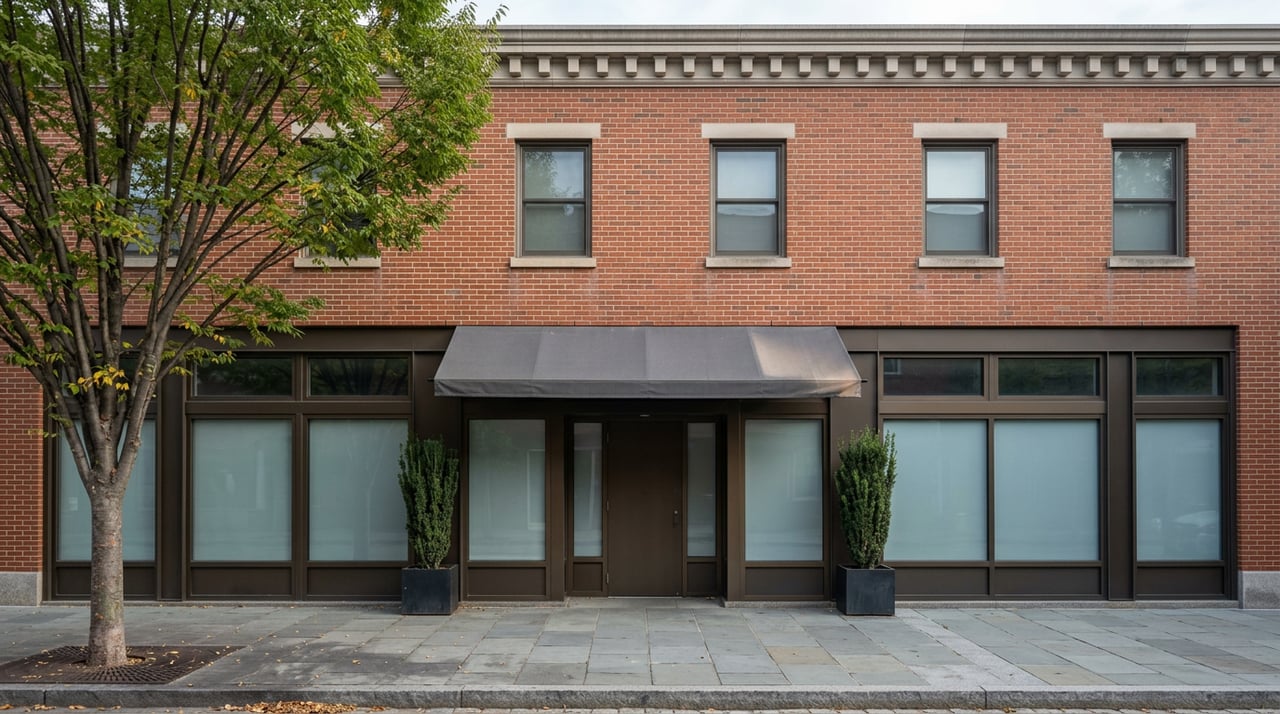
Walk down Washington Street on a Tuesday afternoon and you'll pass a line at All'Antico Vinaio spilling past the door. Walk the same block on a Monday morning and you might have the sidewalk to yourself. Both of those things are true right now, and neither one cancels the other out. That contradiction is the actual story of Downtown Crossing this summer, more than any single grand opening.
For most of the past two decades, the easy explanation for an empty storefront on Washington Street was that nobody wanted to be there. That explanation stopped holding up sometime in the past year. The building at 399 Washington that sat dark since Barnes & Noble moved out in 2006 now has a two-level, 20,000-square-foot Uniqlo inside it, and Mayor Michelle Wu cut the ribbon herself on opening day, April 10, with a taiko drum line and giveaways drawing a crowd down the block, according to the Boston Globe. The old Forever 21 space at 459 Washington, vacant since that chain closed in 2021, reopened June 26 as Teso Life, a three-floor Asian lifestyle store and the brand's only New England location, the Globe reported. Neither of those buildings sat empty because the neighborhood was unwanted. They sat empty because for a long time, nobody could make the math work. Now the math has changed, and it's worth understanding why, because it explains a lot about what the corridor actually feels like day to day.
The Vacancy Number That Doesn't Match the Old Story
Here's the fact that would surprise most people who haven't been paying close attention: retail vacancy along the Downtown Crossing corridor sat at 1.6 percent in the fourth quarter of 2025, a rate that was actually down slightly from the same quarter back in 2019, before the pandemic touched any of this. That is not a neighborhood clawing its way back to where it used to be. That is a neighborhood with fewer empty storefronts than it had before anything went wrong.
Noam Ron of Hudson Group, one of the investors who bought the long-vacant 399 Washington building for roughly $13 million, put it plainly to the Globe this spring: "We find ourselves no longer having to sort of apologize for Downtown Crossing." That's a specific thing to say, and it lines up with what's actually filling the empty units. Just up the block, the Teso Life space carried an asking rent around $37 per square foot, well below market value. That's the kind of gap Whitney Gallivan, a broker at Boston Realty Advisors who helped market 399 Washington, pointed to when she described pitching the corridor to retailers who'd normally only consider Back Bay or the Seaport.
What Actually Moved In This Year
If you've been away from the block for a few months, here's the rundown in the order you'd hit it walking south down Washington Street from Downtown Crossing station:
- Uniqlo, 399 Washington St. Opened April 10. Two floors, over 20,000 square feet, the retailer's sixth Massachusetts location, built into a shell that kept its original exposed brick and central staircase.
- Teso Life, 459 Washington St. Opened June 26. Three floors of Japanese, Korean, and Chinese snacks, beauty products, and toys, the only New England location for a chain that had been eyeing Boston for three years before this site opened up.
- All'Antico Vinaio, 330 Washington St. Opened July 15 at 11 a.m., with the first 100 customers in line getting a free sandwich. This is the Florentine schiacciata chain's second Boston address, following its 2025 debut in Back Bay.
- Skechers, 477-481 Washington St. Was aiming for an opening before the end of July, according to a district manager's hiring post this June, marking the brand's return to a downtown Boston storefront after its previous location closed. That window has now passed, so it's worth checking whether the doors are actually open on your next pass down the block.
- Peach Cobbler Factory, 77 Summer St. Originally aiming for a December 2025 debut, pushed back by construction and permitting delays, and retargeted for a May 2026 launch as of this spring. That target has also slipped without a confirmed opening date as of this writing, so don't be surprised if the windows are still papered over for a while longer.
That's five storefronts, all on or just off the same stretch of Washington Street, within about four months. For a corridor that spent twenty years defined by what wasn't there, that's a genuinely different rhythm.
Why Monday Still Feels Like a Different Neighborhood
None of this means the corridor has fully snapped back to its old self, and the clearest evidence of that is what happens on Mondays specifically. According to a Downtown Boston Alliance count reported by the Globe, total Monday foot traffic through downtown Boston in 2025 came in around 4.2 million, down close to 30 percent from the 5.9 million counted in 2019. That gap is bigger than the corridor's overall recovery. A separate Globe report from December 2025 had citywide weekday foot traffic running about 25 percent below 2019 levels overall, which means Monday specifically is lagging behind even that softer average.
Some of this was always true. In 2019, Monday foot traffic ran at about 88 percent of the Tuesday-through-Thursday average, since Monday has never been downtown's busiest day. In 2025, that ratio slipped to 84 percent, a four-point gap that's grown but hasn't transformed. What's changed is who's around to notice it. Lucas Hausermann, who works at Espresso Love in the Financial District, described the swing to the Globe this way: "On a Monday, you'll have maybe a couple of people in line. On a Tuesday, you could have a line that stretches almost to the door." At the Downtown Crossing Roche Bros., only a handful of registers get staffed on Mondays because there's no line demanding more. A security guard at the Primark on Washington Street, KK Pabon, summed up the mood in three words: "Makes me want to just leave, honestly."
Alli Macina's 25th birthday landed on a Monday this spring, and rather than let that stop her, she took her friends to Versus, an arcade bar on Province Street with $1 wings and free play for students on Monday and Tuesday nights. "I wanted somewhere where all my friends could be and I didn't have to rent out a room or reserve a table," she told the Globe. They had most of the games to themselves.
The New Tenants Aren't Chasing the Old Lunch Crowd
Put those two facts side by side, the empty Monday mornings and the record-low vacancy rate, and a real explanation starts to take shape. The retailers filling Washington Street this year aren't betting on the office lunch rush that used to define downtown weekdays. Teso Life is the only store of its kind in New England, meaning it's pulling shoppers in from well outside a five-minute office radius. Uniqlo's location is a full-scale flagship, not a lunch-hour convenience stop. All'Antico Vinaio picked Downtown Crossing as its second Boston site specifically after its Back Bay location proved the format could draw a following on its own, independent of any particular office building emptying out for lunch.
That's a different business model than the one Washington Street ran on for decades, and it's part of why the two data points that should contradict each other, tighter-than-2019 vacancy and softer-than-2019 weekday traffic, actually coexist without much friction. Downtown Boston Alliance president Michael Nichols has talked about this shift as "office-to-everything," a phrase that covers office-to-residential conversions as well as the broader idea that downtown doesn't need to recover exactly the way it left off. Nichols told the Globe in May that Monday, specifically, is "getting pretty close to playing the same role it used to play," even if it's not there yet. The neighborhood isn't waiting for the 9-to-5 crowd to come back in full. It's building a version of itself that doesn't depend entirely on that crowd showing up.
What's Worth the Walk This Month
If you live in or around Downtown Crossing, the practical version of all this is simple. All'Antico Vinaio is open now at 330 Washington, and the line moves fast enough that a weekday lunch there is realistic without burning your whole break. Skechers had aimed for a late-July opening at 477-481 Washington, so that storefront is worth checking on your next pass, whether or not the signage is up yet. The Peach Cobbler Factory at 77 Summer is still coming, later than either of its original targets, so don't be surprised if the windows are still papered over for a bit longer.
What's changed most isn't any single storefront. It's that walking this stretch of Washington Street no longer means bracing for another dark window. Some days it's still quiet, especially early in the week. But quiet and empty stopped being the same thing here sometime in the past year, and that's worth noticing whether or not you were the one who noticed the vacancy sign come down.
Watching a neighborhood's daily rhythm shift block by block is part of what keeps Michael Egan paying close attention to Downtown Crossing and the rest of Greater Boston. If you're curious what a changing corridor like this means for property values or timing nearby, Let's Connect.